Known as Brotherhood Park when it opened in 1890, Polo Grounds III was the home of a second New York Giants franchise in the Players' League. The latter was a creation of Major League Baseball's first union, the Brotherhood of Professional Base-Ball Players. After failing to win concessions from National League owners, the Brotherhood founded its own league in 1890.
The lone exception has been the 2016 Game in which the AL was the "home" team, despite its being played in Petco Park, home of the NL's San Diego Padres. This was announced after the 2017 All-Star Game was awarded to Miami, marking a third straight game hosted at an NL venue. This was done because, from 2003 to 2016, the league who won the All-Star Game was given home field advantage in the World Series, and MLB did not want to allow the NL to have the last at-bat in an All-Star Game for three straight years.
Similar events
After finishing last in the NL Central with 66 wins in 2006, the Cubs re-tooled and went from "worst to first" in 2007. In the offseason they signed Alfonso Soriano to a contract at eight years for $136 million, and replaced manager Dusty Baker with fiery veteran manager Lou Piniella. After a rough start, which included a brawl between Michael Barrett and Carlos Zambrano, the Cubs overcame the Milwaukee Brewers, who had led the division for most of the season. The Cubs traded Barrett to the Padres, and later acquired catcher Jason Kendall from Oakland. Kendall was highly successful with his management of the pitching rotation and helped at the plate as well. By September, Geovany Soto became the full-time starter behind the plate, replacing the veteran Kendall.
Game-specific uniforms are made every year, but are not worn for the game itself. Instead these uniforms were worn during batting practice and the Home Run Derby. However, starting with the 2021 game, Major League Baseball and Nike would release new All-Star Game uniforms annually, and these uniforms would be worn by the players during the game. Each manager may designate a position player who will be eligible for game re-entry if the last position player is injured or ejected.
Milt Pappas
It was played much less frequently thereafter, although it remained an unofficial Cubs theme song for some years after. The "Steve Bartman incident" was seen as the "first domino" in the turning point of the era, and the Cubs did not win a playoff game for the next eleven seasons. The shift in the Cubs' fortunes was characterized June 23 on the "NBC Saturday Game of the Week" contest against the St. Louis Cardinals; it has since been dubbed simply "The Sandberg Game". With the nation watching and Wrigley Field packed, Sandberg emerged as a superstar with not one, but two game-tying home runs against Cardinals closer Bruce Sutter. With his shots in the 9th and 10th innings, Wrigley Field erupted and Sandberg set the stage for a comeback win that cemented the Cubs as the team to beat in the East.
He then stopped and turned around, as the crowd stood and acknowledged the departure of Franklin D. Roosevelt, who was in attendance that day. The Cubs had no official physical mascot prior to Clark, though a man in a 'polar bear' looking outfit, called "The Bear-man" , which was mildly popular with the fans, paraded the stands briefly in the early 1990s. There is no record of whether or not he was just a fan in a costume or employed by the club. Through the 2013 season, there were "Cubbie-bear" mascots outside of Wrigley on game day, but none were employed by the team.
Cubs Win Flag
Probably the most notable feature of Crosley Field otherwise was the fifteen-degree left field incline, called "the terrace". Most of them were constructed as a way to make up the difference between field level and street level on a sloping block, and most of them were leveled out ("Duffy's Cliff" at Fenway Park and Left Field bump at Wrigley Field are two examples). Around 1960, Powel Crosley was courted by a group seeking to return a National League franchise to New York City to replace the Dodgers and the Giants, who had moved to Los Angeles and San Francisco respectively after the 1957 season. The moves left the American League Yankees as the city's sole baseball team. However, he died the following year and his estate sold the team a few months later to Bill DeWitt, who kept Crosley's name on the park.
It should come as no surprise that the record books for the longest home run ever in baseball history are spotty. MLB history offers reports of truly epic blasts, which we’ll dive into below. But the farthest home run ever documented happened in a Triple-A baseball game. Larry Robinson-USA TODAY SportsWashington Nationals outfielder Juan Soto hit the longest home run in the Home Run Derby in 2021. Taking his swings at Coors Field, the All-Star slugger demolished a 520-foot blast in Colorado that astonishingly went into the third deck of the stadium.
Marlins Park (Miami Marlins)
The Chicago Bears of the National Football League played at Wrigley Field from 1921 to 1970 before relocating to Soldier Field. The team had transferred from Decatur, and retained the name "Staleys" for the 1921 season. They renamed themselves the Bears in order to identify with the baseball team, then a common practice in the NFL. Wrigley Field once held the record for the most NFL games played in a single stadium, with 365 regular season games, but this record was surpassed in 2003 by Giants Stadium in New Jersey, thanks to its dual-occupancy by the New York Giants and New York Jets.
Mordecai "Three-Finger" Brown, Jack Taylor, Ed Reulbach, Jack Pfiester, and Orval Overall were several key pitchers for the Cubs during this time period. With Chance acting as player-manager from 1905 to 1912, the Cubs won four pennants and two World Series titles over a five-year span. Although they fell to the "Hitless Wonders" White Sox in the 1906 World Series, the Cubs recorded a record 116 victories and the best winning percentage (.763) in Major League history. With mostly the same roster, Chicago won back-to-back World Series championships in 1907 and 1908, becoming the first Major League club to play three times in the Fall Classic and the first to win it twice. However, the Cubs would not win another World Series until 2016; this remains the longest championship drought in North American professional sports.
The team had first established a Cubs Hall of Fame in 1982, inducting 41 members in the next four years. Six years later, it began again with the Cubs Walk of Fame, which enshrined nine until it was paused in 1998. As such, every member of those exhibits was inducted into the new Hall of Fame alongside the five most recent Cubs to enter the National Baseball Hall of Fame . The 2021 class inducted one new member with Margaret Donahue (team corporate/executive secretary and vice president) to make 56 names inducted as the inaugural members of the Hall. With the realignment into three divisions and the institution of the wild card in 1995, the Division Series was added.
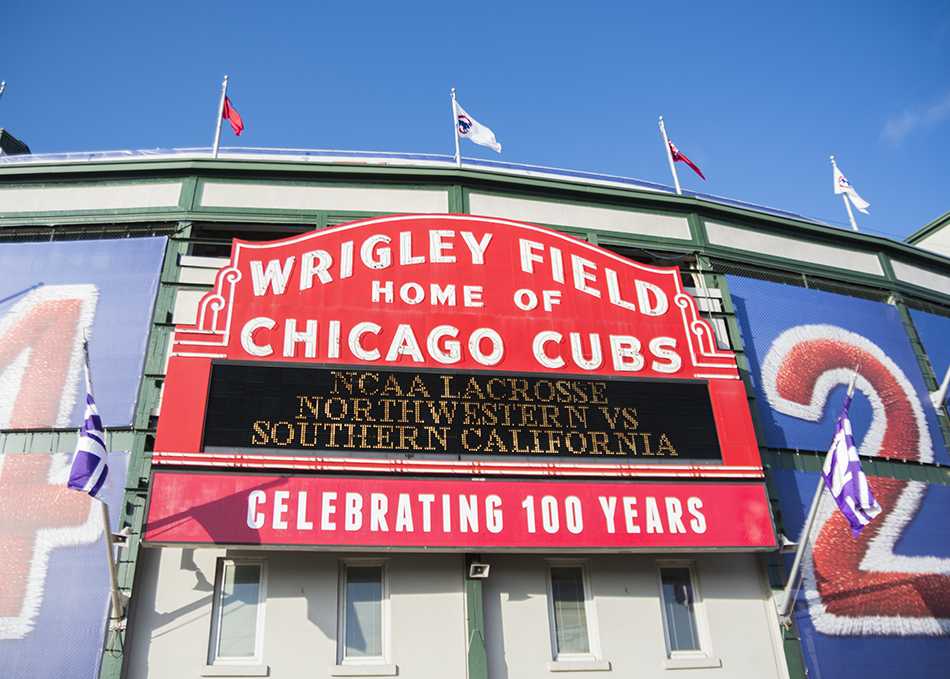
The Cubs also shared the park with the Chicago Bears of the NFL for 50 years. The ballpark includes a manual scoreboard, ivy-covered brick walls, and relatively small dimensions. The divisional winners met in a best-of-5 series to advance to the World Series, in a "2–3" format, first two games were played at the home of the team who did not have home-field advantage. Then the last three games were played at the home of the team, with home-field advantage. Thus the first two games were played at Wrigley Field and the next three at the home of their opponents, San Diego.
A building across from deep right-center field was topped by a neon sign for Baby Ruth candy beginning in the mid-1930s and running for some 40 years. In the early 2000s, following the trend of many ballparks, a green-screen chroma key board was installed behind home plate in the line of sight of the center field camera to allow electronic "rotating" advertisements visible only to TV audiences. By 2006, the board was set up to allow advertisements to be both physical and electronic . Ironically given the roots of its name, Wrigley Field had been a notable exception to the trend of selling corporate naming rights to sporting venues. The Tribune Company, the owners of the park from 1981 to 2009, chose not to rename the ballpark, utilizing other ways to bring in corporate sponsorship.

These were actual bank checks, not the jumbo "display" checks typically used today. For example, if the winner hit three homers in a row, they would receive one check for $2,000 and another for $500 instead of one check for $2,500. As an incentive for throwing good home-run-hitting balls, the pitcher who threw the most pitches for home runs also received a bonus, according to the host. Each inning consisted of three outs, and any ball not hit for a home run, including called strikes, would be recorded as an out. If the two batters tied, extra innings would be played until the tie was broken. In the tables below, players and teams denoted in boldface are still actively contributing to the record noted, while denotes a player's rookie season.




No comments:
Post a Comment