Table of Content
In 1954, for example, the baseball Giants only drew 1.1 million fans despite winning the World Series. Other sporting events held at the Polo Grounds included soccer, boxing, and Gaelic football. Its final sporting event was a pro football game between the Jets and Buffalo Bills on December 14, 1963. Shea Stadium opened in 1964 and replaced the Polo Grounds as the home of the Mets and Jets.
Cubs manager Dusty Baker did not see the play as it happened, because the curvature of the Cubs dugout blocked his view. Center field in the 1950s, with famous Chesterfield cigarettes advertisement visible above the clubhouse. The Polo Grounds' end was somewhat anticlimactic, especially compared to other "Jewel Box" parks.
American Family Field
However, the Philadelphia Phillies cut the lead to two by the All-star break, as the Cubs sat 19 games over .500, but they swooned late in the season, going 20–40 after July 31. The Cubs finished in fourth place at 81–81, while Philadelphia surged, finishing with 101 wins. The following two seasons also saw the Cubs get off to a fast start, as the team rallied to over 10 games above .500 well into both seasons, only to again wear down and play poorly later on, and ultimately settling back to mediocrity. Again, the Cubs' unusually high number of day games is often pointed to as one reason for the team's inconsistent late-season play. He started his career with the A’s and made himself known with a pair of 40 home run seasons. During the 1989 ALCS against the Toronto Blue Jays, after a shortened season held him to 65 games and just 17 homers, Canseco hit the longest home run of all-time.
During the mid-1980s, Anheuser-Busch placed Budweiser and Bud Light advertisements beneath the center field scoreboard. The 1997 home run chase featured McGwire and Griffey, but neither reached it that year. It was during that season that full-fledged interest over the record kicked in as both players were on record pace well into the summer. McGwire finished the 1997 season with 58 home runs following his mid-season trade to the Cardinals, besting Griffey's total of 56 that year.
Major League Baseball All-Star Game
The rooftop seats are now effectively part of the ballpark's seating area, although they are not included in the seating capacity figure. During the 2014 season, the Cubs celebrated the centennial of Wrigley Field. Each decade was represented during ten homestands throughout the season.

He hit the ball to the deepest part of the park in center-field, proving why he show up on our list twice. On April 4th, 1988, Darryl Strawberry opened the season for the Mets with this blast that on its way out to right field hit the top of the roof. The blast has been measured as a 525 foot home run from Strawberry, which ended being first the longest one of his 39 on the season. It was such a literal moonshot into the roof that it came down onto the field of play after smacking the top of the stadium like a bullet. This was one of the last years we got to see a healthy Strawberry on top of his game, but at least he went out with a bang.
Sports other than baseball
In honor of the World Baseball Classic, the 2005 contest featured eight players from different countries. For the first time in Derby history, Shohei Ohtani became both the first pitcher and the first Japanese player to participate in 2021. The inspiration for the event was a 1960 TV series called Home Run Derby. The televised event included baseball legends Hank Aaron, Mickey Mantle, and Willie Mays. Mazara set the MLB Statcast record for home run distance -- not just the Rangers' -- and joined Giancarlo Stanton in the 500-foot club with this rocket to the upper reaches of the upper deck in right field in Arlington.
The most notable of these was "Billy Cub" who worked outside of the stadium for over six years until July 2013, when the club asked him to stop. Billy Cub, who is played by fan John Paul Weier, had unsuccessfully petitioned the team to become the official mascot. This long-established tradition has evolved to fans carrying the white-with-blue-W flags to both home and away games, and displaying them after a Cub win.
The song "Go, Cubs, Go!" by Steve Goodman was recorded early in the 1984 season, and was heard frequently during that season. Goodman died in September of that year, four days before the Cubs clinched the National League Eastern Division title, their first title in 39 years. Since 1984, the song started being played from time to time at Wrigley Field; since 2007, the song has been played over the loudspeakers following each Cubs home victory.
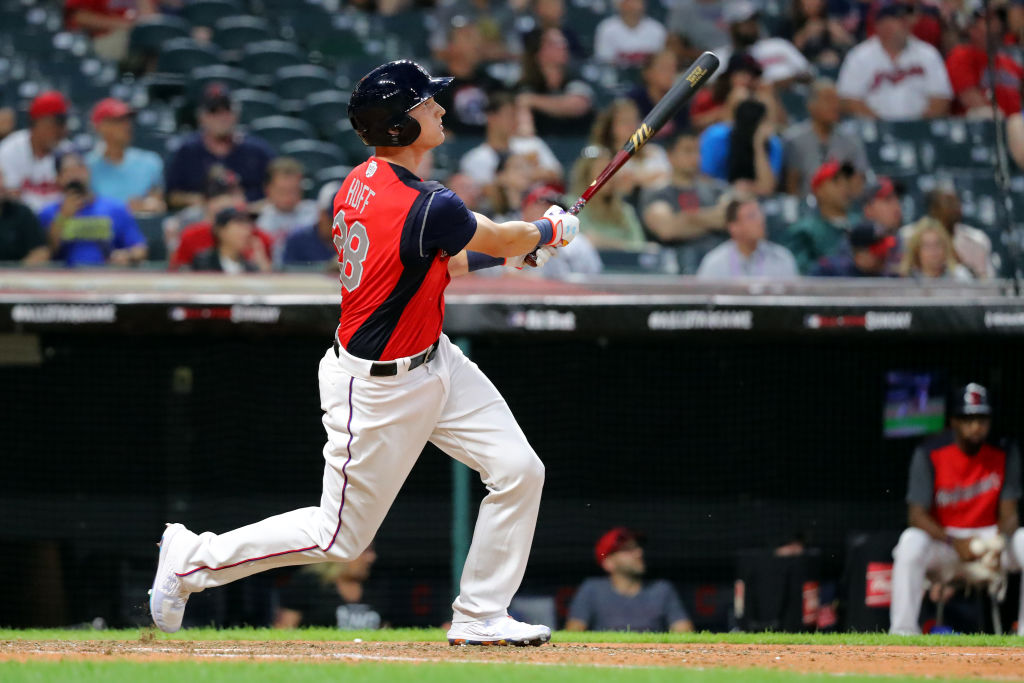
In the first game, the National League All-Star Team wore gray uniforms with navy blue letters spelling "NATIONAL LEAGUE" across the front of the jersey with "NL" caps. From 1959 to 1962, two All-Star Games were held each season, in order to increase the money going to the players' pension fund. This practice ended after the owners agreed to give the players a larger share of the income from a single game. Because of the game's TV popularity, invited players have felt pressure to participate. Notably, Ken Griffey Jr. initially quietly declined to take part in 1998, partly due to ESPN scheduling the Mariners in their late Sunday game the night before. After a discussion with ESPN's Joe Morgan and another with Hall of Famer Frank Robinson, Griffey changed his mind, and then won the Derby at Coors Field.
However, as a tradition, Cubs fans inside and sometimes even outside the park will promptly throw any home run ball hit by an opposing player back onto the field of play, a ritual depicted in the 1977 stage play Bleacher Bums and in the 1993 film Rookie of the Year. With the wind blowing in, pitchers can dominate and no-hitters have resulted. The last two by a Cubs pitcher occurred near the beginning and the end of the 1972 season, by Burt Hooton and Milt Pappas respectively.
The Yahoo Sports team will bring NFL fans expert football and fantasy analysis, breaking news and live questions from social media throughout the entire first round. In addition on Day 1, we’ll have Matt Kelley from Player Profiler with analytics, player comparisons and breakdown numbers you won’t find anywhere else. During the 2016 season, Bartman received renewed media attention as the Cubs progressed through the playoffs. On Saturday, October 22, 2016, the Cubs were again at home with a 3–2 lead in Game 6 of the NLCS, similar to the 2003 NLCS game.
After a poor season in 1960, the "Ragamuffin Reds" put everything together in 1961 and won the National League pennant, an effort documented in pitcher Jim Brosnan's book, Pennant Race. The dream season ended for the Reds at the hand of the Yankees, whose slugging duo of Roger Maris and Mickey Mantle had demolished the rest of the American League. Maris, who had set a record with 61 home runs that season, also knocked one into the Moon Deck in the ninth inning of Game 3 of the World Series.
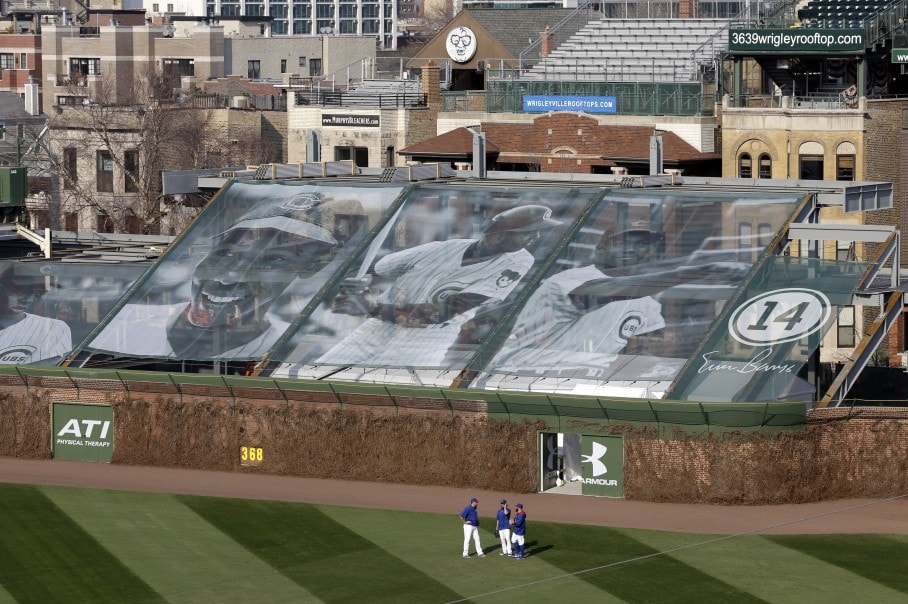
The left and right field bullpens were relocated to enclosed areas under the bleachers, the brick walls were extended toward the field, and new seating was added in the vacated bullpen areas. Partial façade replacement and concourse restoration was completed along Addison Street, along with structural improvements to the right field bleachers. The outfield turf was replaced just weeks before the start of the season. The Cubs Plaza building just to the west of Wrigley was finalized, and the "Park at Wrigley", the area above Cubs players dressing rooms, was in use for fans before and during games. Construction of Hotel Zachary along the west side of Clark Street was ongoing. During the offseason, the bleachers in both outfields were expanded and the stadium's footprint was extended further onto both Waveland and Sheffield Avenues.
Early club history
The third Polo Grounds, built in 1890, was renovated after a fire in 1911 and became Polo Grounds IV, the one generally indicated when the Polo Grounds is referenced. It was located in Coogan's Hollow and was noted for its distinctive bathtub shape, with very short distances to the left and right field walls and an unusually deep center field. Gotham Bowl The Polo Grounds was the name of three stadiums in Upper Manhattan, New York City, used mainly for professional baseball and American football from 1880 through 1963. The original Polo Grounds, opened in 1876 and demolished in 1889, was built for the sport of polo. Bound on the south and north by 110th and 112th streets and on the east and west by Fifth and Sixth avenues, just north of Central Park, it was converted to a baseball stadium when leased by the New York Metropolitans in 1880.





No comments:
Post a Comment